woensdag 12 augustus 2009

Measuring - the soft and the hard way

Making things measurable is an often overlooked part of our job as a PM. It sounds hard to make things tangible, but it's not. There's definitely more stuff available than you imagined. But .. don't rush. Start with thinking back about quality. What's that? It's conformance to requirements. Which requirements do u have documented? Are your objectives "s.m.a.r.t.?". If they're not, redesign them first before you start to measure something at all!

Once you tackled that, think about what you actually want to measure. Do your stakeholders understand what the concepts are in your project, do you understand them correctly? Make sure this is set right as soon as possible. Which data do you have available? Realize which data you might have but isn't available yet? How can you get that data? Once you have your data, try to realize how you might need to transform your data to get right to what you want to measure (there are entire methodologies for this, especially in the BI and CPM world, have a look at "semma" - Mother Google will tell you more). Maybe you can work with a "sample" instead of the whole data set? Try to find a statistically relevant sample.

Think about how you want to visualize. Is your target audience graphically oriented? Do they prefer text? Will u use this measurement frequently or one-time?

Are there any other measurements you can "inspire" yours on, do you know who created them or do u know anyone who's a subject matter expert on the other measurement? This is especially applicable for "soft" measurements. What are your corporate values? Can these inspire you to make your measurement more tangible? You may have a "project satisfaction survey" for your customer, but did you ever think about a "project member satisfaction survey"? Just an example to illustrate that non-tangible (or "soft") measurements can be implemented without any problems at all.

What to remember? Quality, s.m.a.r.t., which data do and don't you have. Good luck!

maandag 2 maart 2009

Communications management - part 1

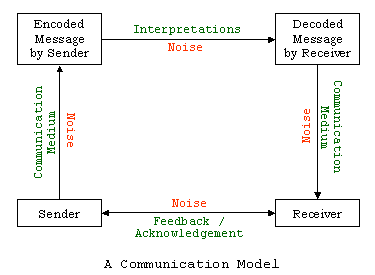
The PMBOK mentions the 'general communications model'. It talks about personality and perception screens and things like that. You can find some kind of model here.

Communications must be thoroughly planned, it is incredible how much time is spent communicating and how quickly something could escalate into something unexpected. Example. I receive a mail from a stakeholder from the UK. I am quite proud of liking British comedy, therefore assuming I understand British humor. There was a joke in there and I didn't see it coming. I even called the guy to check if we could arrange something and that I thought it would be OK.

It turned out that the small remark in the mail was just meant to "pull my leg" and I didn't get it. Only because it was an e-mail and I did not get any body language, tone of voice or other context. Quite fascinating.

Plan your channels of communication well and be rewarded during each phase of your project.

dinsdag 27 januari 2009

Hierarchy of needs

Project managers often neglect the fact that they have a thorough responsibility over the HR aspect of their projects as well. This means that "everything HR related" you simply cannot immediately delegate to other stakeholders. There are some concepts you need to be very well aware of. One of them is the "Maslow's hierarchy of needs". It can help you in understanding, when a stakeholder issues a certain concern, 'how deep' this concern really is touching the person or his or hear team.

You can find many interesting sources of info on the web, just google on "maslow hierarchy of needs". Essentially, it means that the basis of what drives us is 'physiological', then on top of that we have 'safety'. The top three levels in the 'pyramid' are 'love/belonging', 'esteem' and 'self-actualization'. The top levels need the support of the underlying levels, otherwise the pyramid...well...just isn't stable anymore.

If you're just starting to read about PM, start with The Triangle.